
Georges Bastard
A French artist born on 26th July 1881 in Andeville (Oise).

Georges Bastard (pronounced Bat-tard) came from a family of artists who were tabletiers. Tabletiers were craftsmen who specialized in making intricate small-scale objects from delicate materials such as ivory, horn, mother-of-pearl, tortoiseshell, and precious woods.
He studied at the École des Arts Décoratifs in Paris from 1896 to 1900 before returning to Andeville to help with the family business.
He moved to Paris in 1908 and initially set up his business at 58 rue Richere, where he continued his work mainly as a fan maker.
Bastard was able to refine the technique used in fan making to create the famous 1911 “barley ears” fan. The barley ears fan was so well received that it was placed in the Luxembourg museum the following year. It is currently shown at the Musée d’Orsay (Paris).
In 1912, he set up his workshop and store at 16 rue Sainte-Cécile, where he remained until his death.
During his Nouveau period he would produce boxes, letter opener knives, candy boxes, bowls, and jewellery, as well as numerous fans.
In the 1920s, he participated in the decoration of Emile Ruhlmann’s furniture sets in salons and exhibitions. It was at this time that he began working as a publisher and worked in conjunction with other artists including metal worker Paul Kiss and as a freelance designer for other retail outlets.
Member of the Salon d’Automne and the Comité des Tuileries, one of the founders of the U.A.M. He participated in all the major exhibitions in France and abroad.
Our interest in Bastard however is in his works from the Art Deco period. During his art deco period he participated in salons such as the Salons of the Society of French Artists, the Salons of Decorative Artists, and the Salon d’Automne, of which he was a member. He exhibited with great success at the International Exhibition of Decorative Arts in 1925 and 1937.
It was in the late 1920s and early 30s that a Porcelain company named ROBJ would gain popularity with their porcelain figures and it was during this time that Bastard would work with them to create his own line.
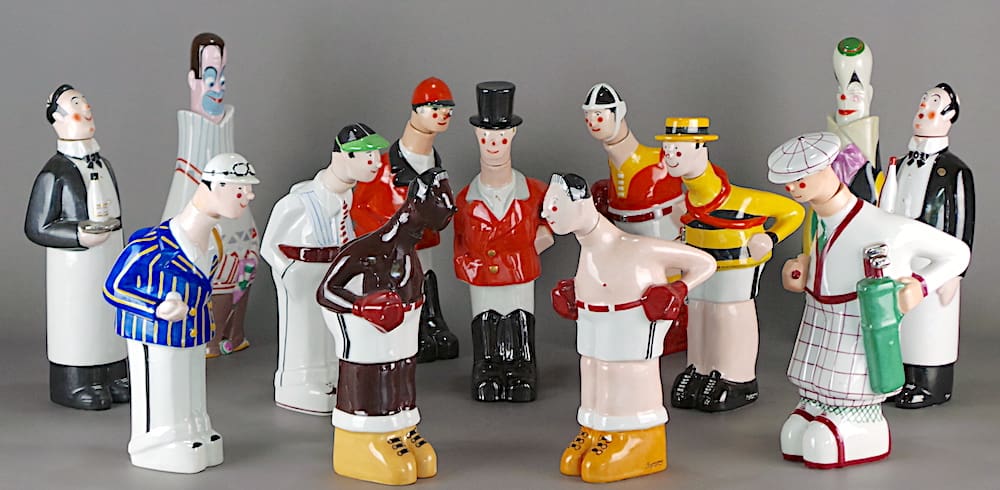
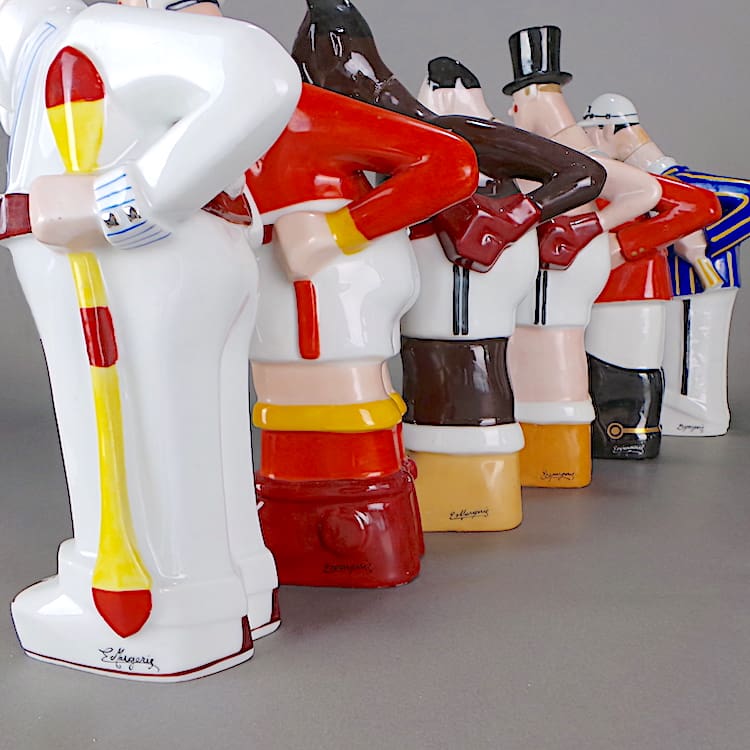
Bastard would commission E. Margerie (of which we can find limited information on) to create a series of alcohol bottles for Robj. Margerie created a magnificent series of porcelain alcohol bottles in the style of athletes. The items would sometimes bare a black duck silhouette logo and Marjorie signed many, but not all pieces to the boot.
The athletes were a Rugby player, Tennis player, Golfer, Boxers (one white, one black), horse riding huntsman, a rower and a walker.
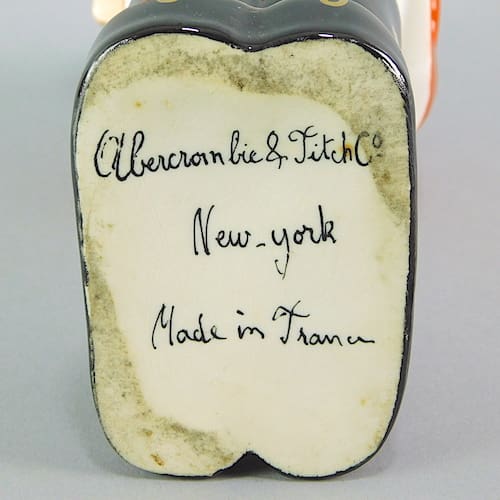
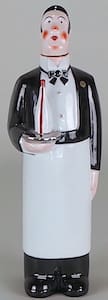
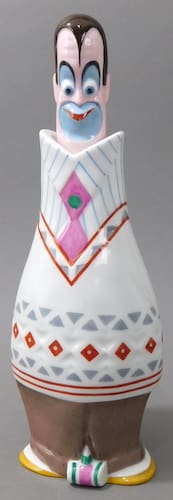
Bastard also made porcelain clowns and comical waiters, produced for different liquor companies. During the 1920s there was a race held between waiters known as the course des Garcons de cafe (cafe boys race). Bastard signed the under-neither for individual businesses; Abercrombie and fitch and a strawberry company are some of the examples we currently have or have previously owned.
Other designs include ceramic boxes, dressing table sets, jugs and pitchers, nightlights. Sometimes for Bernardaud & Cie Limoges. We know that Goebel produced the golfer and was produced with or without Bastards signature. It is possible that Goebel produced their own version of the same design stamped Goebel.
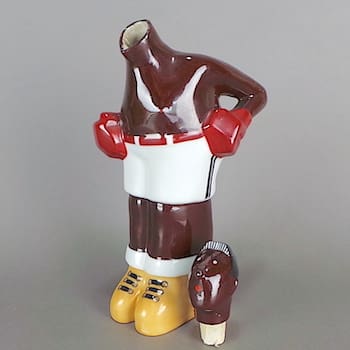
These sports flacons are now very rare, many having lost their head stoppers over the years. They are rarer than the Robj Flacons and more desirable in my opinion.
In 1935, he became director of the National School of Decorative Arts in Limoges and curator of the Adrien-Dubouché Museum. In 1938, director of the National Porcelain Factory in Sèvres. Named Knight of the Legion of Honor in 1925 and Officer in 1937.
On March 28, 1939, he died in a railway accident in Beasain, Spain before reaching the age of 58.