
A – B – C – D – E – F – G – H – I – J – K – L – M – N – O – P – R – S – T – U – V – W – Z
Ebena
The company of Ebena produced pieces in its factory in Wynegham, Belgium and worked from 1921 – 1931. It produced articles it described as ‘Articles de Fantaisie et articles industriels en matiere moulee’. This is the title of the Book on Ebena, produced by the Kunst Museum Dusseldorf (made in 1987).
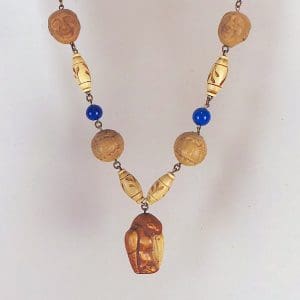
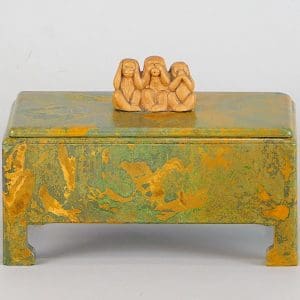
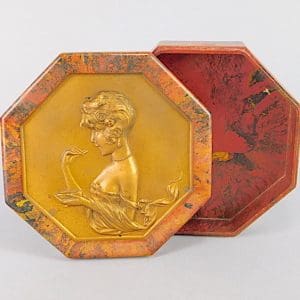
Items that included lamp bases, ashtrays, radios, urns, clocks, light pulls, necklaces, humidors and boxes were made of an early galalith-bakelite material. It was squashed in to the moulds using gold and silver leaf which added a stunning glitter to the pieces.
Most of the boxes and lamps tend to have a figural finial handle, often in the form of Pierrot, Egyptian cats, and Buddha’s, deco ladies and tassels.
Ebena does tend to fade with age but you can usually see the amazing original colours inside where it has not been exposed to too much light. They are still stunning pieces that are collected world wide. You will find several pieces on my websites.
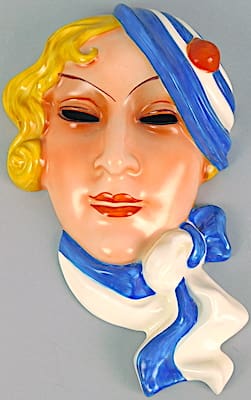
Erphila Ceramics
American ceramics company famous for its wall masks.
Often marked with reverse E and R letters standing for Ebeling & Reuss who founded the Erphila Company in Philadelphia, PA during the art deco years.
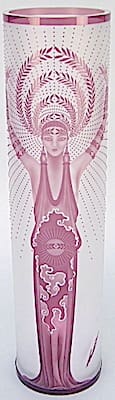
Erte, Roman de Tirtoff (1892 – 1990)
Renown for his fashion Art Deco designs for theatre and magazines etc. Erte defined it as the fusion of the curvilinear designs of Art Nouveau of the 19th Century with the Cubist, Constructivist, and geometrical designs of modernity. He was also influenced by Persian miniatures and would often use a brush with a single hair to complete his gouache paintings.
His imagination was limitless, and Erte designed costumes, stage sets, jewellery, art objects, sculpture and ceramics.
Unlike many artists who work freely before a canvas or sketchpad, Erte developed his own unique process: he would visualise the entire work of art in his mind until it was complete in every detail, and then create the work from his ‘mind’s eye.’
Erte is considered one of the most influential artists of the 20th century.
Etling – Edmond Laurent Etling
La Societe Anonyme Edmond Etling was founded in 1909, at his foundry he produced top quality ornamental items, where you could buy the most exclusive art objects of that time including bronze, and bronze and ivory statues, ceramics and glass.
The glass pieces were usually made for Etling at the Choisy-le-Roi glassworks. He opened a shop in Paris at 29 Rue de Paradis. Here he sold his wares which were designed by top freelance designers of the deco period like Alliott, Alonzo, Chiparus, Gazan, Bel, Guiraud-Riviere, Descompe, Godard, Pierre Le Faguays, A. Godard, Auroroe Onue, Claire-Jean Roberte Colinet, Lucille Sevin and her husband Jean Theodore Delabasse, Gazan, Georges Beal and Marcel Guillard.
These artisans were all leading members of the French modern art movement of that time and by creating ideal circumstances for them, Etling played a significant role in the style, which later became known as Art-Deco. Etling pieces are famous for their innovative design and quality and are today highly sought after. Their entire output was produced during the Art Deco period as the company did not survive the second world war.
Etling items are now highly sought after.
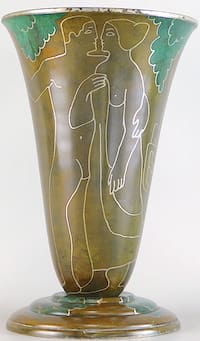
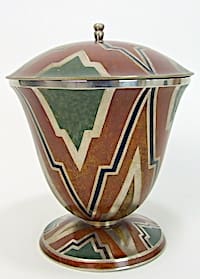
Evolution
French dinanderie company worked with Paul Louis Mergier (1891 – 1986). Produced metal dinanderie items in copper, silver and enamel. Mainly vases but some other items like bowls and chargers etc.
Fanny Rozet (1881-1921), French Art Deco sculptor and also an important member of the ‘Evolution Group’ in Paris, who is believed to have used the pseudonym of ‘Fanrose’.