
A – B – C – D – E – F – G – H – I – J – K – L – M – N – O – P – R – S – T – U – V – W – Z

Mackintosh, Charles Rennie (1868 – 1928)
Scottish architect and designer who was one of the most influential figures in the development of Art Nouveau and the Modern movement. Much admired on the continent especially by the Viennese Secessionists. Formed the ‘Glasgow Four’, which included Herbert MacNair and the Macdonald sisters. Margaret later married Mac Nair and Mackintosh married Frances.
Magrou, Jean
French sculptural artist worked in the deco years. His father was a lithographer. He studied at the Lycée Henri IV where he worked mainly on mythological bronzes. He married in Paris the niece of the painter Jean-Andre Rixens.
Professor of modelling and drawing at the Sorbonne, he participated in 1907 in the teaching cooperative created by Marie Curie. Later in his career he created a few Art Deco studies. Jean Magrou is buried in the Old Cemetery of Béziers.
Majorelle, Louis (Jean Sylvestre Majorelle) (1859 – 1926)
Born on 26th September 1859 he was a French art nouveau furniture maker and designer, in his latter years he also produced a few Art Deco designs – although they are very rare.
After 1901 formally served as one of the vice-presidents of the Ecole de Nancy. He used mainly rare and exotic fruit woods often with inlays of tortoiseshell ivory, ebony and metal. His work in wood often resembled a painting.
He used different woods to add colour to his pictorial creations on tables and cabinets. Using cherrywood, oak, walnut, ash, holly, beech and pear woods for his monochrome colours. His art nouveau work often bears the organic swirls now recognised as true art nouveau.
Most of his pieces were signed with the Majorelle inlay signature which took several different forms. The amazing works of Majorelle are now highly sought after worldwide. He died on the 15th January 1926.
Manship, Paul (b. 1885)
Born 1885 in Minnesota, USA. Studied at Pennsylvania Academy and St Paul Institute. Studied in Rome 1909-1912 and won the Prix de Rome. Exhibited in the USA and France, winning many medals and awards.
Marquet, Rene Paul (1875 – 1939)
He studied sculpture at the Ecole National des beaux arts in Paris under the guidance of Emmanuel Fontaine and Alexandre Falguiere. He worked in bronze and bronze and ivory and most of his pieces were art nouveau.
Martel Brothers (1896 – 1966)
Twins Jan and Joel Martel were born in 1896 in Nantes. They worked during the deco years and beyond until 1965 producing sculptures, monuments, fountains and other decretive Art Deco items with a cubist styling. Also carried out interior designs for top Parisienne villas.
They signed their pieces Martel. They participated in many of the Paris exhibitions and salons including the decorative arts exhibition of 1925 where they showed in collaboration with Robert Mallet-Stevens a study known as the cubist trees.
In 1926/1927 Mallet-Stevens built a mansion for the two brothers. Jeans wife was a famous painter. Both died in 1966, 6 months apart.
Martin Brothers (1873 – 1942)
The Martin Brothers (Robert Wallace Martin, Charles Douglas Martin, Walter Frazer Martin and Edwin Bruce Martin) created some of the most attractive, as well as most sinister, stonewares to have been made in Britain, personified the Arts & Crafts ideal of the artist-craftsman. In his younger years Wallace (Robert Wallace) worked as a stone carver on the decorations of the Houses of Parliament. It was here that he came into contact with the heraldic beasts & grotesque gargoyles which were to have such an influence on his work in later years. Apart from a few modelled pieces done in terracotta the majority of their pieces were salt glazed stoneware.
Massier, Clement – Ceramics
The Massier company started in 1707 and was handed down through family members. It was famous for its metallic lustre glazes. One of its best known ceramists was Jean Barol (1873 – 1966).
Masson, Jules Edward (b. 1871)
French Statuary artist born Paris 1871. Worked in conjunction with the Max Le Verrier foundry in the late 20’s and early 30’s. Received a medal of honour and several awards, mainly in the 1920’s.
Maxence, Edgard (1871 – 1954)
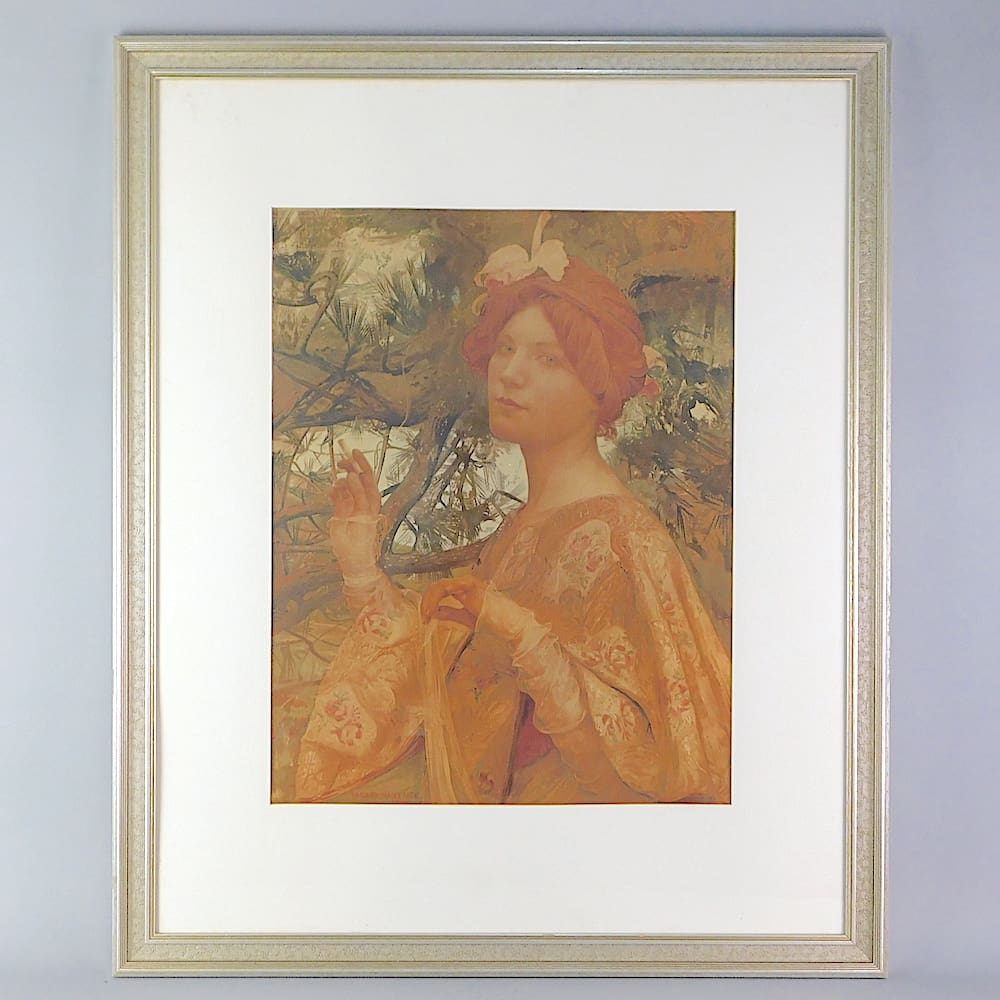
Born in Nantes, 1871, died in La Bernerie-en-Retz, 1954. French Symbolist painter.
He was a pupil of Jules-Elie Delaunay and Gustave Moreau at the Ecole des Beaux-Arts, Paris, and helped to popularise Symbolism in the 1890’s by applying a highly finished academic technique to Symbolist subjects. His best-known paintings, which include Girl with a Peacock (before 1896, Paris) the Soul of the Forest (c. 1897 Nantes) are decorative, vaguely religious or allegorical images of beautiful women in medieval dress, influenced by early Italian Renaissance and late English Pre-Raphaelite art. Maxence often enriched the surface of his works with gold or silver foil and gilt plaster relief and mounted them in elaborate frames of his own design.
He also painted fashionable portraits such as Woman with an Orchid (1900 Paris) and Impressionist landscapes. Though he participated in the avant-garde Salon de la Rose + Croix between 1895 and 1897, Maxence exhibited successfully at the conservative Salon des Artistes Francais from 1894 to 1939 and frequently served on its committees and juries. Maxence’s work changed little in style and content after the turn of the century and, despite the condemnation of progressive critics, continued to enjoy strong middle-class patronage until the late 1930’s.
Maxim George (Geo)
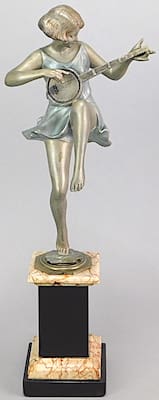
There is no info on Geo Maxim, although I am very familiar with his work as I have had so many pieces by him.
I believe he was a French artist worked mainly during the 1920’s and 1930s in France, produced most of his pieces in spelter (white metal) with a few bronzes, terracottas and ceramic pieces. More of a middle market sculptor, he also produced a few earlier Nouveau statues.
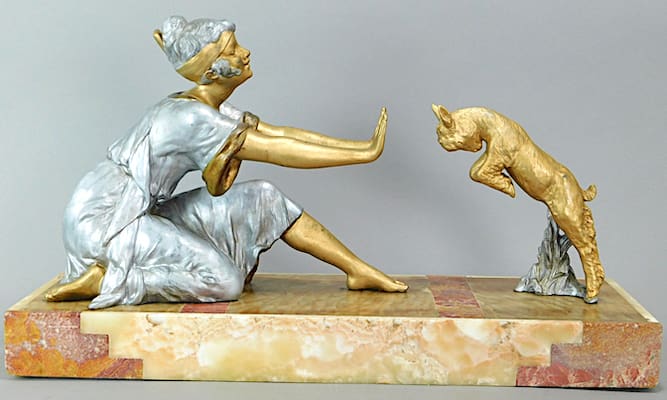
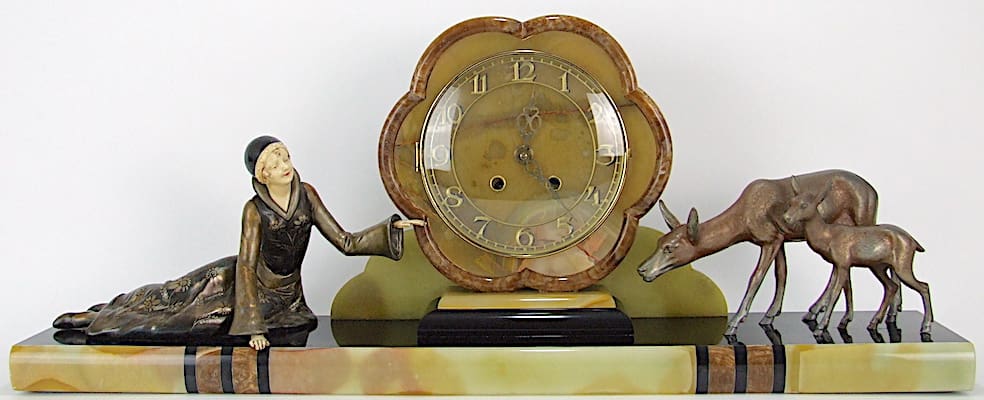
His designs which were mainly ladies or girls were used to produce figural lamps and clocks as well as groups and statues on their own. Most famous piece was the running lady with two greyhounds.
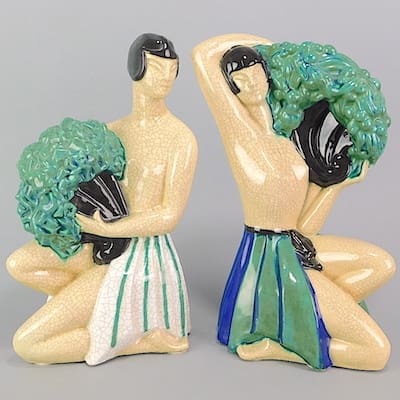
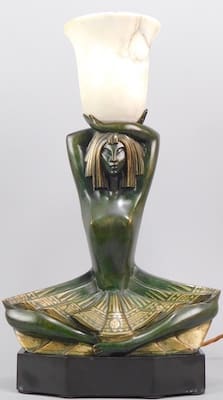
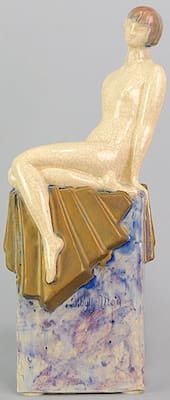
May, Sybille
English statuary artist who worked in France in the interwar period and definitely from 1925-1935. Her work was very cubist and stylised producing work in bronze and ceramic.
She belonged to the La Stele and Evolution groups, often working with Pierre Le Faguays and Edouard Cazaux.
The Goldscheider foundry in Paris produced many of her bronzes and ceramic pieces although the publisher Albert Buisson of Editeur d’art also produced her works. Her statues are now highly sought after as they are very modernist in style.
MAYER, Nicolas
Born in Paris in mid 19th century, studied under Cordier and exhibited genre and allegorical figures at the Salon des Artistes Francais, attaining an honourable mention in 1887 and becoming an Associate in 1904. His group titled ‘The Dream’ can be seen the Roanne Museum.
Melani, Salvatore (b. 1902)
Italian born artist who worked in France. Most of the Melani statues were made for the middle and lower market. His statues were made in plaster, shelter and a few bronzes.
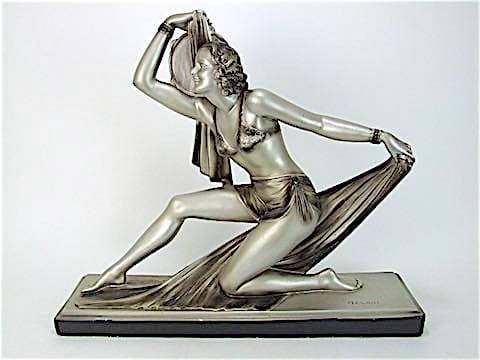
Melo, (see Lemoine)
French art Deco sculptural artist – actual name Jean Lemoine. Also I believe worked under the pseudonym Lemo.
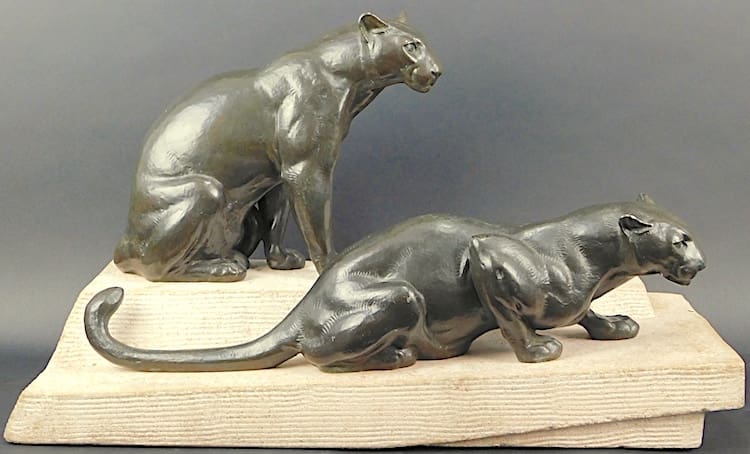
Meriadec
A pseudonym used by Charles Delhommeau on his anamaliers statues mainly produced by the Le Verrier foundry.
Menneville
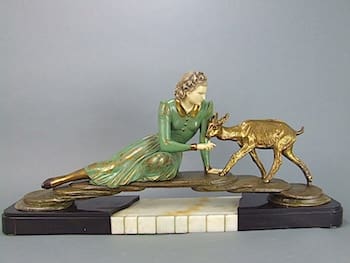
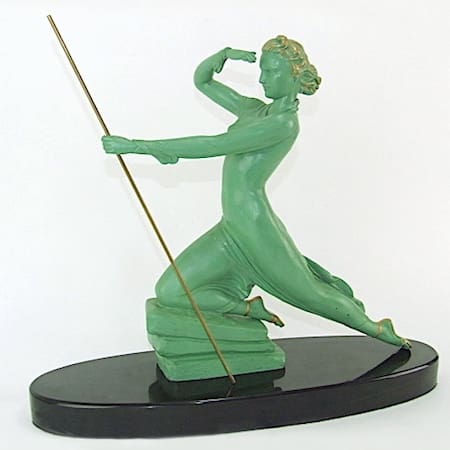
Until recently it was thought that Menneville was a French artist who produced statues of mainly spelter and ivorine or full spelter. However now – after having discussions with the Lydia Cipriani – daughter of Ugo Cipriani my opinion has now changed. There seems to be a connection between Menneville and Cipriani. In discussions with Lydia I have been informed that her half brothers mothers name was Madelaine Bouchetot de Menneville. I believe it is too much of a coincidence that the Menneville statues are very much in the style of Cipriani’s work. Also I have had signed Menneville’s that Lydia believes are the work of her Father. I know for a fact that many of the works of Cipriani, Menneville (and Rochard) were produced by the Silvin foundry in Paris during the early 1930s. Therefore I conclude it is highly likely that Menneville was a pseudonym used by Ugo Cipriani on his spelter and spelter and Ivorine pieces.
His bronzes and terracottas were usually signed Cipriani and many were unsigned as were many of the spelter statues. Some Menneville signed statues are titled Menneville et Rochard. I now also believe that this was due to a marriage of artists on some of the group statuary pieces, ie. a lady and a dog – where Menneville (Cipriani?) produced the lady of the group and Rochard provided the dog.
There are also two other names that occur on some of the ivorine and spelter statues in the style of Menneville/Cipriani and they are Roggia and Deviggo. Were these also pseudonyms used by Cipriani? After all it was a common practice with many of the statuary artists during the deco years to use other names. For instance – Le Faguays used Fayral, Bouraine used Derenne and Briand on his non-bronze statues and many other artists also used pseudonyms. Please see my information on Cipriani for dates etc.
I would like to thank Ugo Cipriani’s daughter, Lydia and son Gabriel for this important information on Menneville/Ugo Cipriani.
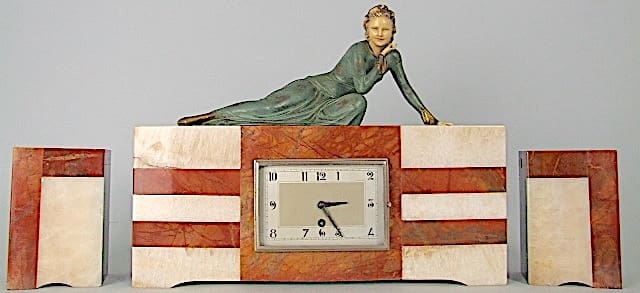
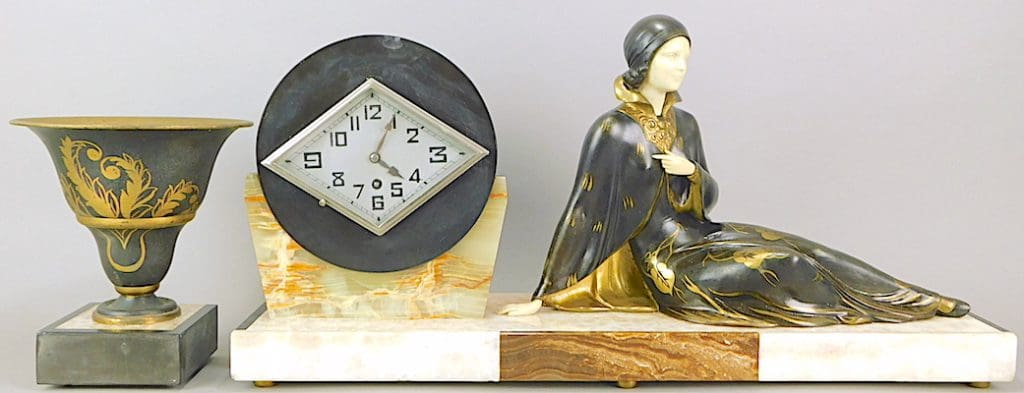
Mequinion, Roger (1905 – 1985)
A French ceramics artist who attended the Ecole des Beaux Arts in Paris during the deco years 1920s – 1930s. He worked for and with Lalique on sandblasting and designs. He later applied this process to ceramic items such as vases. During the 1940s he worked in Aubagne which at this time was an important art ceramic centre with many artists and workshops. The most important was Proceram. Whilst there he met the director of Proceram and started to work with this company on a process that was equivalent to the Lalique process, sand blasting but on ceramics. A thick layer of enamel type glass was applied and then using stencils sandblasted back to create shapes and figures similar to those on Lalique pieces.
Milet, Henri (1907 – 1987)
The son of Paul Milet, who like his father spent his working life at the family Porcelain factory in Sevres France. Paul Milet trained as a ceramist and took over the running of the factory in 1931, retiring in1971. An extremely talented ceramist, Milet exported to the USA large quantities of porcelain. He was also an accomplished sculptor. Production was marked MP Sevres prior to Henri taking up post. The mark was subsequently changed to PM Sevres and this has caused some confusion, with much of the production being attributed to Paul Milet. Apparently 30% of the works signed MP are in fact by Henri Milet as well as all works signed PM. This company should not be confused with the Manufacture de Porcelaine de Sevres.
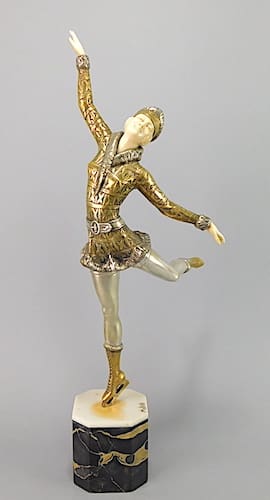
Molins-Balleste, Enrique Henri (1893 – 1958)
Enrique Molins-Balleste was born in Barcelona and later moved to Paris. Molins and Balleste are one and the same artist and he would use either Molins or Balleste to sign his pieces, sometimes signing them BAL.
Some same figures are signed Molins whilst the other is signed Balleste. He also used the pseudonym – Gual (his wife’s name Gual-Cuberes.
Famous for his theatrical and genre groups and figural lighting.
Worked in different mediums – shelter, Bronze, Bronze and Ivory, ceramics and wood.
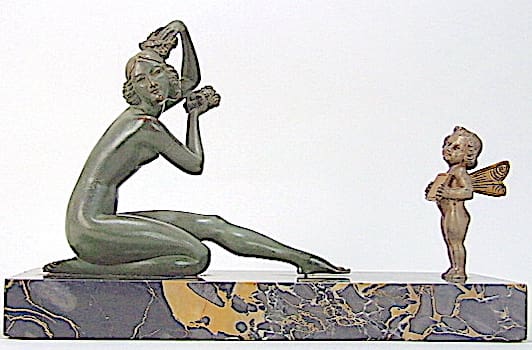
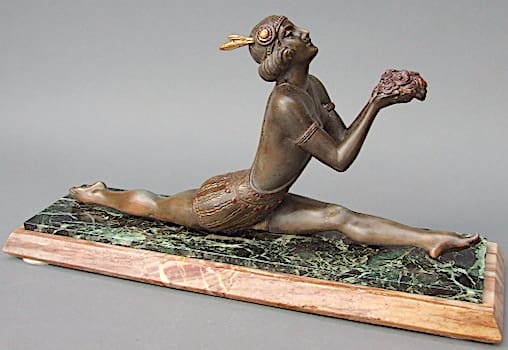
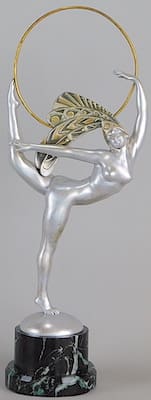
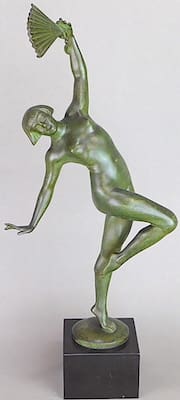
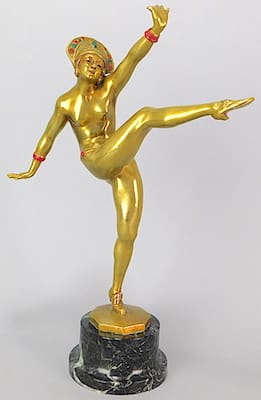
Morante, Maurice
Early 20th century sculptor.
Moreau, August (1834 – 1917)
Born in Dijon, France, he studied under Mathurin Moreau. Auguste Moreau worked as a sculptor and specialised in figures, statuettes and groups, mainly in marble. He made his debut at the 1861 Salon in Paris and continued to play an active part in the Salon des Artistes Francais as a member of the Societe des Artistes Francais until 1910. – worked 1860 – 1910, prolific nouveau spelter and bronze sculptor.
Moreau, Francois Hippolyte (1832 – 1927)
Born France 1832, he studied under Jouffroy in Paris. Exhibited at the Salon from 1863, winning a bronze medal at the Exposition Universelle of 1900. He specialised in Genre groups and figures. worked 19th century into the 20th century. Possibly used the pseudonym Franjou as there appears to be a connection.
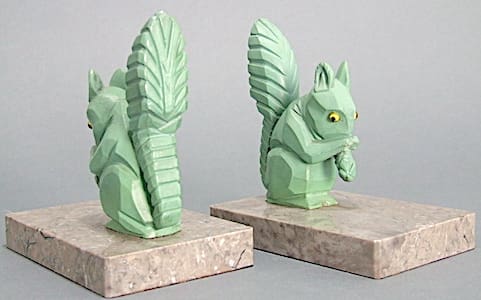
Morlon, Alexandre (b. 1878)
Born 1878 in Macon France. He studied under Falguiere and Mercie and Exhibited at the Salon in 1900. He specialised in allegorical figures and is famous for the standing figure of Victory used for the Allied Victory medal (1918).
He modelled pieces used for coinage, medals and war memorials. Examples of his work can be found in the Mint Museum, Paris and the Ghent museum.
Morris, William (1834 – 1896)
Morris was one of the founders of the Arts & Crafts Movement and closely involved with the Pre-Raphaelite artists of the mid 19th c. His ideal of integrating art, literature and graphic design inspired a generation of artists like Rossetti, Burne-Jones, Millais and Waterhouse to name but a few. Morris was an English poet, writer, designer, artist and socialist reformer. He rejected the opulence of the Victorian era and urged a return to medieval traditions of design, craftsmanship and community. He pioneered modern renderings of antique styles of type as well as the production of high quality home furnishings to last for generations. In 1861, he founded the firm of Morris, Marshall, Faulkner & Co. with Gabriel Rossetti, Burne-Jones, Madox Brown and Philip Webb and in January 1891 He founded the Kelmscott Press.
Muller Freres (c1900 – 1933)
A wonderful glass making firm mainly known for their cameo glasswares, run by the brothers, Henri and Desiree Muller. Based in Luneville, near Nancy and Croismare. The brothers initially worked with Emile Galle.
MULLER, Charles Arthur (b. 1868)
A sculptural artist who studied at the Ecole des Beaux Arts Paris and studied under Hector Lemaire. Worked in bronze, bronze and ivory and ceramics.