
A – B – C – D – E – F – G – H – I – J – K – L – M – N – O – P – R – S – T – U – V – W – Z
Sabino
French glass company – makers of architectural lighting and objets d’art during the 1920’s – 1930s, who’s shop was at 17 Rue St Gilles, Paris.
Sandoz, Edward Marcel (1881 – 1971)
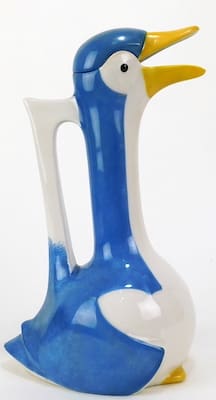
Along with Francois Pompon and Rembrandt Bugatti, Swiss born Edouard-Marcel Sandoz was one of the leading animal sculptors of the 20th Century.
After studying Chemistry in Geneva, he moved to Paris to study at the prestigious Ecole des Beaux-Arts. His work focused on both human and animal forms in bronze and stone. All of his sculptures are characterised by a geometric form which is strongly influenced by both the Art Nouveau and Art Deco styles.
Sandoz bronzes are increasingly collectable today, commanding premium prices. He is also well known for his design work for the Haviland porcelain company in Limoges, France, which resulted in many distinctive porcelain objects in the form of animals. Source – Tikiri Wanduragala.
Sandoz is one of the most famous animalier artists of the Deco period along with Pompon, Kelety, Laurent, Moreau and Le Verrier. He also produced portraits, monuments, terracotta’s and ceramic items. His animals frequently have a humorous and stylised quality and have been likened to the famous animals by Marcel Bouraine. Many items are very small and all work by Sandoz is now highly acclaimed and sought after.
Scarpa – Ricardo (1905 – 1999)
of Italian descent. Famous sculpture and medalist working in mainly terracotta animal studies. Very much in the pompon cubist style. Student of Loto and Carlo Lorenzetti at the Royal Academy of Venice. He arrived in Paris in 1928. He received a gold medal for all of his works in 1974 at the Salon du Grand Palais, France. Present in many French and Italian museums. He also worked in conjunction with the Le Verrier foundry on several of his pieces.
Schaff
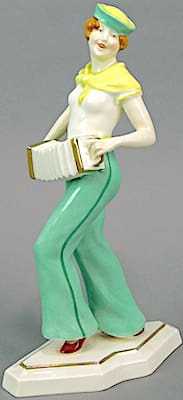
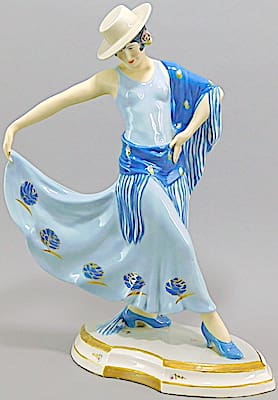
A ceramics sculptural artist who worked alongside Elly Strobach (1908-2002).
Both artists worked for Royal Dux.
Schlevogt, Henry (1904 – 1984)
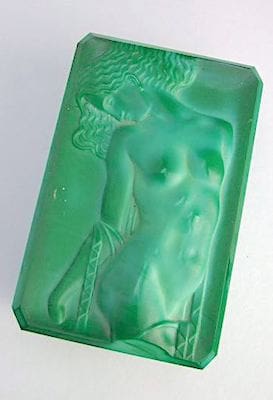
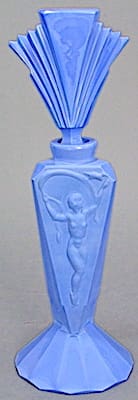
Famous Czech Art Deco glass maker, Schlevogt was the only son of Curt Schlevogt who was a Jewish jewellery artist working in the 1920s. Henry produced Art Deco intaglio items like vases and boxes. Often working in conjunction with his Father-in-law – Heinrich Hoffman. After the death of Schlevogt’s wife (the daughter of Hoffman) the two artist joined forces and produced highly coloured malachite and lapis lazuli glass items and rare coloured glass. This line was called the Ingrid line, named after Schlevogt’s daughter.
Based in Paris in the 1950s, Henry Schlevogt opened a wholesale trade in crystals and glassware on rue de Paradis, as producer and as exclusive distributor of Val d’Andelle glassworks. He made a fortune with this and sold this business in 1972. He died in Paris in 1984.
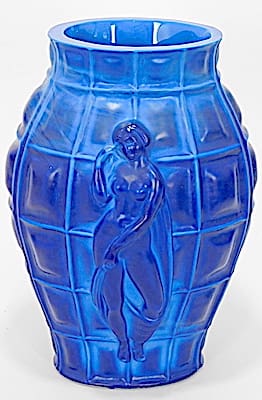
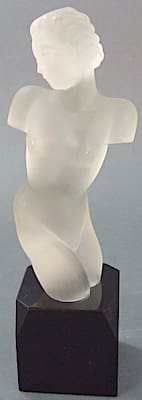
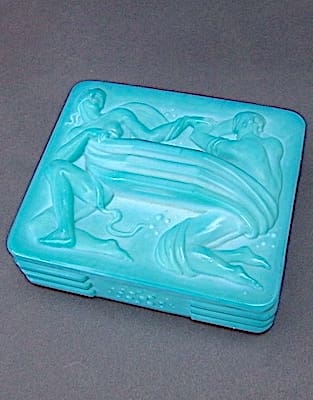
Heinrich Hoffmann (1875 – 1939) and Henry Schlevogt (1904 – 1984) are relatives thanks to the marriage of the latter to the daughter of Hoffman, both artists, established in Gablonz in North Bohemia, can hardly be considered separately, because they worked in continuity, sometimes with the same design moulds, which were all exclusively pressed by the powerful family glassworks of Josef Riedel established in Polaun (Polubný).
Production ceased with the occupation of the Sudetenland by Nazi Germany in 1938, soon followed by the invasion of the rest of the country (Czech republic) and foreshadowing the general conflagration of the continent, and was a part of the tragic backdrop due the chain of personal events that awaited him.
Schmidt-Kassel, Gustav (1867 – 1954)
German statuary artist studied in Berlin, Italy Paris and Russia. Worked mainly in bronze and bronze and ivory. His pieces were produced by Preiss-Kassler and by Rosenthal.
Schneider, Charles (b. 1881)
Born in Chateau-Thierry, near Paris, on 23rd February 1881. At an early age he moved with his family to Nancy, the artistic centre of France, where he later studied at ‘L’Ecole des Beaux Arts’. He was a talented student and he used his abilities to engrave medals using his own designs. After his military service, from 1901 to 1902, he specialised in the art of glass and stone sculpture.
His brother, Ernest Schneider, started working for Daum in 1903, where he was an important designer. Two years later Charles joined the factory as a self-employed designer while continuing his studies in Paris. In 1909, the brothers decided to start their own business and bought a small glass factory, specialising in electric light bulbs, in association with a friend Henri Wolf, at Epinay-sur-Seine. This factory was known as ‘Schneider Freres et Wolf’ and it operated until 1914, when the brothers joined the army; the factory appears to have been closed until they were demobbed in 1917. The factory re-opened in 1917 under the new name of ‘Societe Anonym des Verreries Schneider’. At this time, public taste still favoured the Art Nouveau style, and the factory produced mainly cameo glass with floral and animal designs, and vases with applied handles and bubbles. Apart from the introduction of art glass, half of the production was of commercial drinking glasses.
In 1918, fire destroyed the studios at Galle and a group of artists went to Schneider’s to continue their production for Galle. This period was of great importance to Charles Schneider because he acquired the technique of ‘marqueterie de verre’ from Galle’s artists. This technique, similar to marquetry in wood, is where the design is carved out of a vase and filled with coloured glass. By 1920, the factory was working at full capacity making mainly art glass. In 1921, Schneider started new trade marks for his cameo glass, signing it ‘Le Verre Francais’ or ‘Charder’. Sometimes a vase or lamp would bear both signatures. The idea was to popularise art glass and make it more accessible to the public. Le Verre Francais was mainly sold at department stores like Gallery Lafayette, Le Printemps and Le Bon Marche. Pieces signed Schneider were sold by specialist art shops such as Delvaux, Rouard, La Vase Etrusque and Le Grand Dep’t.
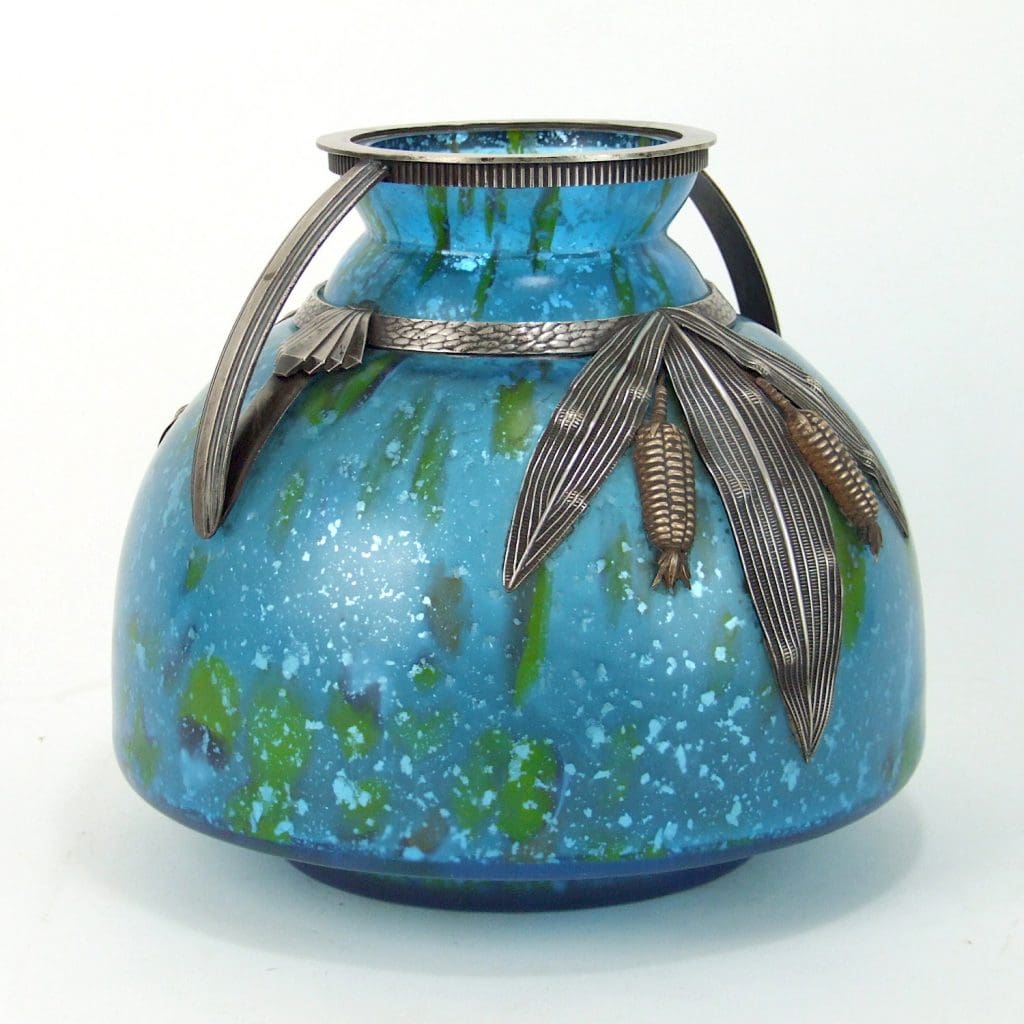
Le Verre Francais was made exclusively using the technique of acid etching, which gave good quality at a low price. The technique of wheel engraving through different layers of glass was used only for special pieces. In 1924, the Schneider’s moved to a bigger factory with more modern furnaces, employing more people, and they changed the name again to Verrerie Schneider. After the 1925 exhibition, various new designs were created and the factory expanded to employ about 500 workers. Blank glass was also supplied to art shops (Delvaux etc.) to be decorated (enamelled, painted etc.) by their own artists, and commissions were received from perfumery companies like Coty. At this time, the company was at its peak due to the good designs of the previous years, such as the new style created in 1920 using new shapes and contrasting colours by applying black foot and handles to brightly colored vases and coupes, thus giving them a dramatic effect. Always innovative, Schneider created a new technique of ‘coloured powders’ whereby the pulverised glass was mixed with metal oxides to obtain different colours and then spread on a flat surface.
The glass blower would roll a gather of glass on the desired colour, which would melt and adhere to it; he would then blow it a little and repeat with different colours as many times as necessary to obtain the desired colour layers. It was then blown into a mould to give the final shape of vase, which would then be acid etched or wheel engraved, making the contrasting colours visible. Finally, the vase was polished in selected areas of the design to give a contrast of shiny and frosty surfaces. Typical designs were clear bubble or crackled glass between upper and lower bands of art deco motifs in overlay. Many of Schneider’s art vases and lamps were exported to America. After the Wall Street crash of 1929 demand dwindled and the factory started to decline. During the 1930’s production of art glass was down to a few pieces a day as they concentrated on making simple designs with less colours for the local market. In 1940, during the war, the factory was requisitioned by the German troops and used as a restaurant. After 1945, Charles Schneider and his son started working for a firm that specialised in enamels, called Soyer. In 1949, they opened a new factory called ‘Schneider’ but most of the designs were the creations of the son, using only crystal and clear glass. Up until Charles Schneider’s death in 1953, only crystal was produced until the factory was closed in 1981. Charles Schneider signed his glass on four different ways . . .
* Schneider
* Charder ( Charles Schneider )
* Le Verre Francais
* A little piece of wool ( candy cane ) in the colours red, blue and white, these were the French colours of freedom and were only used for one year in 1918.
Sega
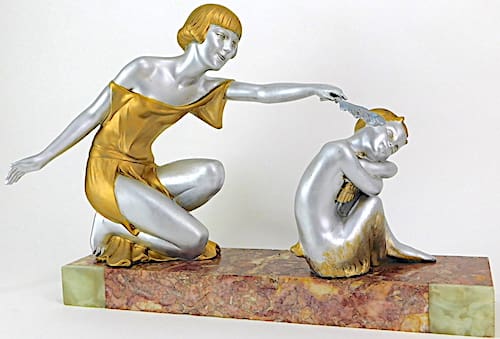
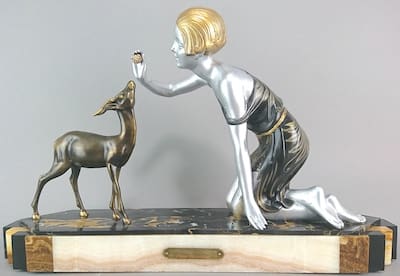
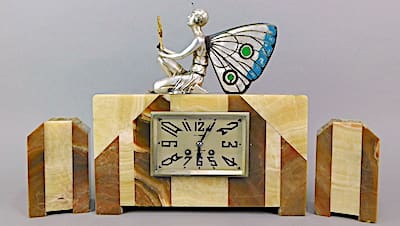
Again, no information. I believe this artist was French, or certainly worked in France, produced many figural items including lamps and clocks.
Worked mainly in spelter and made many pieces using celluloid materials as covering for wooden bases and clock surrounds, with faux tortoiseshell and pearlised finishes.
Used a lot of classical subjects – Pan, Pannette and Diane the Huntress.
Seger, Ernst (1868 – 1940)
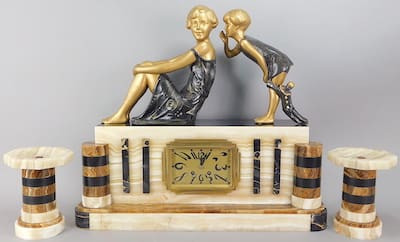
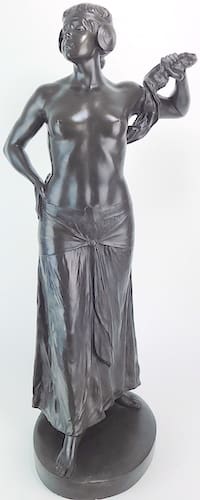
Born in Neurode, Silesia, he studied under Christian Behrens and worked in Berlin, specialising in memorials, portrait busts and classical groups with a penchant for unusual subjects. His works include genre figures of wrestlers, nudes and dancers.
Seifert, Victor Prof. (1870 – 1953)
Seifert was born in Vienna in 1870 and worked in Berlin for most of his career, he participated in the Grosse Berliner Kunstausstellung or Munchener Glaspalast exhibitions.
His statues were produced by top German Foundries such as Ges. V Gladenbeck Sonh. He carried out several commissions and created several monuments for the city of Berlin.
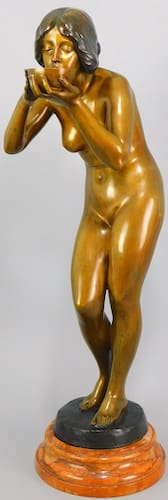
He is a well listed artist with many of his works shown in the Berman book of Bronzes. One of his most famous statues is Trinkende (Thirsty), a delicate female nude bather, but he is better know for his military statues.
His work is considered on par with artist as Villanis and Barrias. Many of his statues can be found in the Schiffer book of Bronzes.
Shayo, Alberto
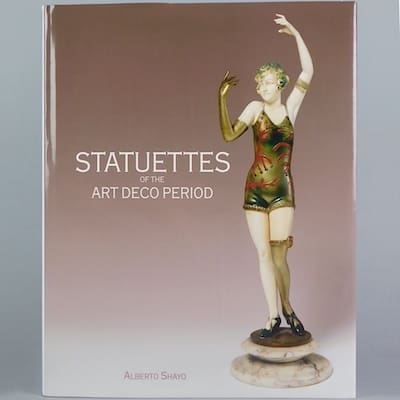
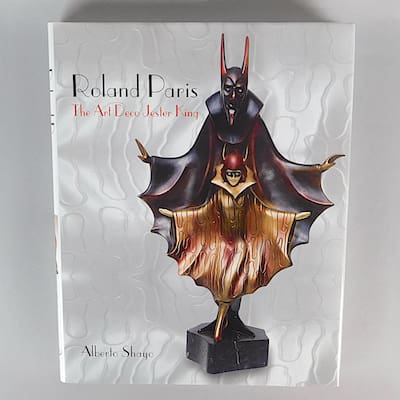
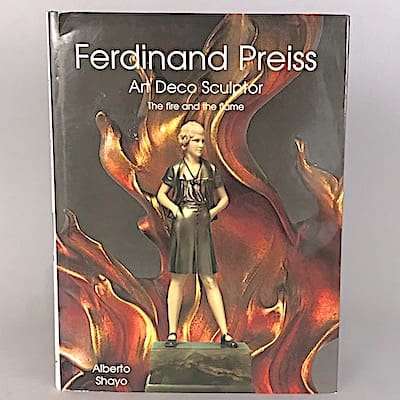
Not an art deco sculptor, nor an artist but a writer of books on art deco subjects and well worthy of a mention in this section. I’m lucky enough to call Alberto a friend and always enjoy our chats on everything deco.
Born in Buenos Aires, Argentina before gaining 2 degrees in the UK, he became a dermatologist. He decided to give that up and put all his attention into art deco and writing. He has produced a number of books on art deco personalities and general art deco subjects like statues. He now lives in Rio De Janeiro and works as an art consultant in addition to writing.
We have a selection of his books for sale via the website and recommend all of them. Extensively well researched and written, they contain biographies of the artists and contain photographs of some of the greatest works of art produced during this period.
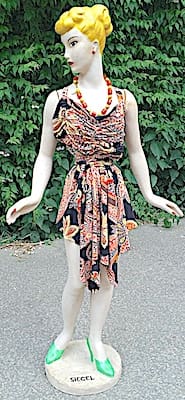
Siegel, Paris
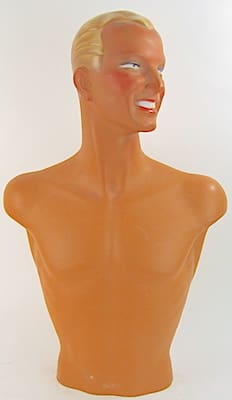
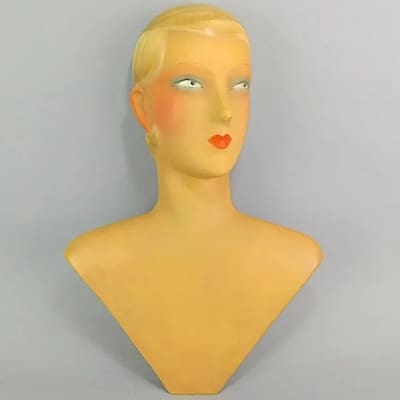
The Siegel shop fittings company supplied most of the Parisian stores with their mannequins during the deco years of the 1920s – 1930s.
They also produced shop signs and modernist mannequins designed by Rene Herst.
The company also worked with the Parisian company of Stockman who produced mainly tailors dummies.
V.N. Siegel of Siegel and Stockman, Paris, established in 1867, experimented with articulated legs, arms and wooden hands with bendable digits in an effort to more closely mimic human activities and later in 1925 startled the display industry with modern abstract mannequins closely following the Art Deco style.
The company are still in operation today.
Silvin
Paris foundry producing art deco statues in bronze and spelter (regule) or Des bronzes and Fontes d’art as they say on the front of their foundry catalogue. The foundry was called Silvin and was at 2 Rue des Arquebusiers Paris.
Simard, Marie-Louise (1886 – 1963)
Born in Paris in 1886 little is known about Marie-Louise Simard, but gradually more information is being found. She appears to have spent her early years in Monaco and was originally a stonecutter. It is through this work that she appears to have developed a knack for sculpting. She is predominantly a bronze artist and would create many luxury items in the 1920s and 30s although she has also produced a number of paintings and works in ceramic. Her works are usually identified with the signature M.L. Simard and many display Paris foundry markings.
Her bronze subjects were primarily female nudes and animal sculptures – the nudes are described as graceful while the animals were often stylised. One of her most famous pieces is the Trojan Horse. I have seen it finished in a plain gold and also with a particularly beautiful Dinanderie finish. Another well sought after piece is “woman in a canoe” which shows a stylised woman in a canoe with parcel gilt decoration.
She is known to have exhibited in Paris salons during the late 1920s and in commercial galleries.
Today her sculptures can reach tens of thousands of pounds in Auction.
Simonet Frères (1919-1970)
Charles and Albert Simonet, active between 1919-1939. In 1919 they took over a foundry that specialised in gilt bronze works for candelabra, lamps and bases for lamps. They modernised the boundary and concentrated mainly on lamps in the art deco style. Albert Simonet was the bronze specialist and soon collaborated with Henri Dieupart and together they designed lamps, vases and clocks, often with geometric motifs or stylised floral motifs.
Sinko, Armand,
Sculptor and painter worked during the deco years. Italian Mother and Hungarian Father. Worked his skills at a young age and entered the Ecole des Arts Decoratifs when he was only 14 years old. After a few years he then went to Paris where he worked in the studio of Maurice Brianchon at the Ecole Nationale des Beaux Arts Superieure. At the age of 21 he won the Grand Prix of the Mediterranean and the first Grand Prix of Rome. He went to Rome in February 1956 to become a resident at the Academy of France, residing at the Villa Medici until April 1959. From 1950 to 1960 participated in exhibitions in Venice. He became an art teacher in high school French in Rome until 1968. Later he moved to southern France, in Grasse, where he was born.
Skeaping, John Rattenbury (b. 1901)
Born the son of a painter, Kenneth Skeeping, in 1901. His artistic career took him through several art colleges ending with scholarships at the Royal Academy schools. He won the Prix de Rome in 1924 where he went to study marble carving. In the early 1920’s he married the famous sculptress. Barbara (Skeaping) who is best known for her minimalist, organic forms in wood, stone and other media and her home and studio in St.Ives, Cornwall, England has been preserved as a site of public interest. Barbara was to have a profound influence on Skeaping who’s work gradually became more stylised and simple. He returned to England in 1926 and was introduced to Frank Wedgwood by Felton Wreford (manager of the Wedgwood showrooms in London who also introduced Keith Murray to Wedgwood a few years later). With the revival of figure making and the need for fresh ideas, Wedgwood commissioned Skeaping to produce a series of animal figures. A total of fourteen figures were designed, the first of these being a Deer.
Spanglett
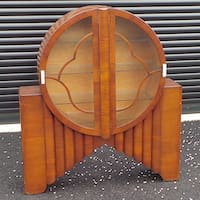
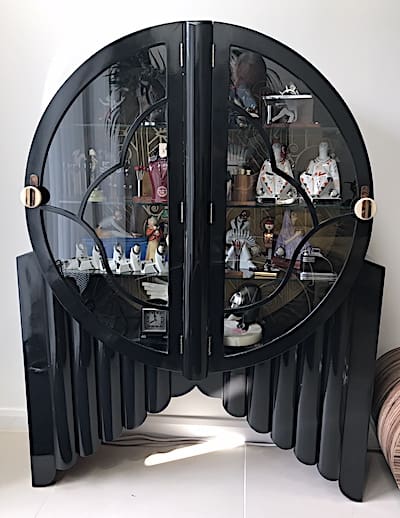
English furniture company. famous for producing the art deco rocket display cabinets.
Stein, Lea (b. 11 February 1936)
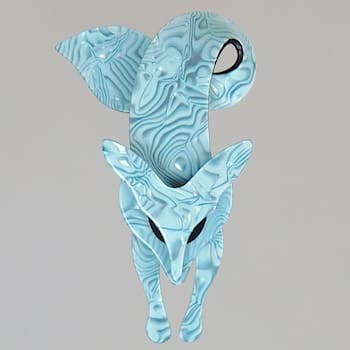
Lea Stein was born in Paris in 1936 and trained as an artist at a young age.
She married Fernand Steinberger in the 1950s. She was once a designer for Coco Chanel.
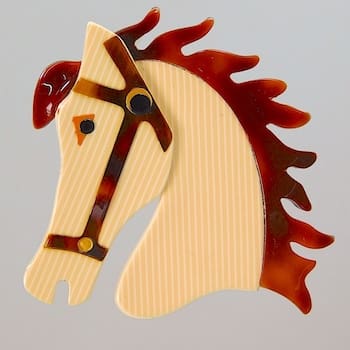
In the 1960s she left Chanel and formed her own jewellery company making unusual and original jewellery items, with the help of her Husband who was a chemist. He created the formula used to create the the laminated celluloid which her jewellery is made of.
The Lea Stein company worked in 2 different periods. Initially from 1969 to 1981 and then from 1991 until the present day. These different periods are referred to as “vintage” and “modern“.
Subjects of Lea Stein brooches vary from cars and hearts to Celebrities and animals.
Prices vary according to whether it is an vintage or modern piece, if the specific piece is still in production and its rarity.
Some of her pieces are no longer in production although she is still working today producing the more modern items. Her main focus now appears to be brooches and her earlier items such as boxes, vanity mirrors, rings, necklaces and earrings are no longer in production and rarely available.
Much more information can be found on our Lea Stein Blog post. We currently have one of the largest, if not the largest collections of Lea Stein items available for purchase.



Stickley, Gustav (1847 – 1942)
An American furniture designer. He opened a factory in New York producing furniture made by the traditional construction methods with an Arts and Crafts feel, notably his range of ‘Craftsman furniture’. The Stickley name is associated with plain furniture in solid mainly American white oak, often described as ‘mission style’ because of its similarity to pieces found in 19th century American mission churches.
Subes, Raymond (1871 – 1970)
French wrought iron artist working during the deco years. His work is considered as on par with Edgar Brandt. At the Exposition of Decorative Arts in 1925, he worked for several of the pavilions, most famous for Ruhlmann’s ‘Hotel du Collectionneur’ (Hotel of the Collector) salon. He is also famous for the works carried out for the large ocean liners of the time – The Ile de France in 1927, The Atlantic in 1932, The Normandy in the mid 1930s and The Liberty in the 1950s. He also produce large works for banks and shops and smaller items such as window panels, doors, staircases, table lamps and ceiling lamps.

Sudre
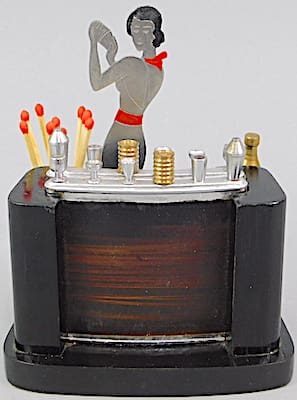
French artist producing 2-dimensional novelty items, usually in chrome. Cigarette dispensers, statues, cocktail stick sets, all with a cute comical theme similar to Benjamin Rabier pieces.
Some of the Sudre pieces are also marked Cado which I believe was the company who produced them. Similar 2 dimensional items are sometimes signed Pizette and Brette. However these could of course have been pseudonyms used by Sudre as many artists around this time used pseudonyms.
Sue et Mare
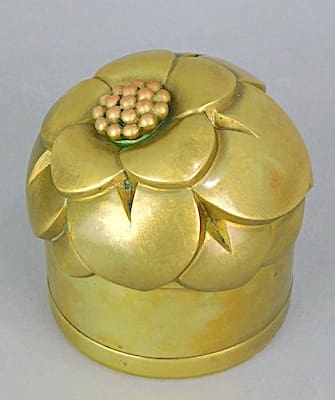
Louis Sue and Andre Mare, both originally painters and Sue was also an architect, founded the firm La Compagnie des Arts Francais in 1919. They collaborated to produce high quality are deco items and many of their designs were inspired by cubism. They exhibited at many of the Paris Salons. The pair worked on many interior design projects as well as creating individual, stylish furniture items, clocks, lighting and an assortment of other interior accessories. The company was sold to the galleries Lafayette department store in 1928 and Sue and Mare left the company due to creative disagreements with Jacques Adnet. Items created by Sue et Mare and now highly sought after and command extremely high prices.
Louis Sue (1875 – 1968)
The lack of a design or craft training led both Sue and Andre Mare to be grouped with the Colouristes in Paris before the First World War. Mare was involved with Duchamp Villon’s Maison Cubiste in 1912, while Sue worked with Poiret until the founding of La Maison Martine in 1912. In the same year, Sue set up his own decorating firm, L’atelier Francais, and began his association with Mare in 1914. This association became a partnership in 1919 with the foundation of La Compagnie des Arts Francais which lasted until 1928. Sue et Mare worked across the spectrum of the decorative arts from wallpapers to furniture. Their furniture used exotic woods and was clearly inspired by traditional French styles. At the 1925 Paris Exposition their pavilion, Un Musee d’Art Contemporian, rivalled Ruhlmann’s and the firm also exhibited furniture in the Ambassade Francaise and the Perfums d’Orsay boutique among other pavilions. The partnership ended in 1928 and Sue continued work in France throughout the 1930’s. Sue lived in Istanbul and taught fine arts there. He was made a Chevalier of the legion d’honneur in 1925.
Andre Mare (1887 – 1932)
Andre Mare was an artist, and studied at the Academie Julian. Louis Sue also trained as a painter, but turned to interior design as early as 1905. This lack of a design or craft training led both Sue and Mare to be grouped with the Coloristes in Paris before the First World War. Mare was involved with Duchamp Villon’s Maison Cubiste in 1912, while Sue worked with Poiret until the founding of La Maison Martine in 1912. In the same year, Sue set up his own decorating firm, L’atelier Francais, and began his association with Mare in 1914. This association became a partnership in 1919 with the foundation of La Compagnie des Arts Francais which lasted until 1928. Sue et Mare worked across the spectrum of the decorative arts from wallpapers to furniture. Their furniture used exotic woods and was clearly inspired by traditional French styles. At the 1925 Paris Exposition their pavilion, Un Musee d’Art Contemporian, rivalled Ruhlmann’s and the firm also exhibited furniture in the Ambassade Francaise and the Perfums d’Orsay boutique among other pavilions. The partnership ended in 1928 and Mare went back to his original painting pursuits and he died in 1932 from Tuberculosis due to the lasting effects of mustard gas poisoning. Mare made a Chevalier of the legion d’honneur in 1926.