
A – B – C – D – E – F – G – H – I – J – K – L – M – N – O – P – R – S – T – U – V – W – Z

Vallet-Bisson, Frederique (1862 – 1949)
Vallet-Bisson was born soon 29 April 1862 in Amiens but moved to Paris, where she became a pupil of Jules-Joseph Lefebvre at the Academie Julian. She showed works at the Paris Salon from 1890 to 1945 and exhibited at Chicago World Exposition in 1893.
Van Den Bossche, Dominique (1854 – 1906)
Born and worked in Belgium, producing Art Nouveau statues.
Van Der Straeten, Georges (or Joris) (1857 – 1938)
Born in 1857, Ghent, Belgium. Studied law by day and sculpture by night, but his love of the art won over and he became a professional sculpture. He studied under G. Kasteleyn and Jef Lambeaux. By 1878 he had become one of Brussels most prolific sculptors. He moved to Paris on advice of his friend the renown painter, Jan Van Beers and became well known for his figures of clowns, pierrot, ragamuffins, circus performers, buxom peasant girls and seductive Parisian ladies. He also gained recognition for his portrait busts of contemporary notables and beautiful women. He had an uncanny skill at capturing facial expressions which clearly portrayed sadness or joy. Some of his female figures are very similar to Emmanuelle Villanis pieces. He worked in Paris and exhibited at the salon from 1912 onwards.
Van de Voorde, Georges-Abel Vandevoorde (1878 – 1964)
Born Kortrijk (Belgium) 1878, died 1964 Anderlecht. Sculptor and medallist. He was a pupil of (among others) Constant Devreese and Julien Dillens. Helped Victor Rousseau and worked as his atelier for 7 years. He also taught and later became president of an art-academy.
He won the Second Price Godecharle in 1905 and regularly showed his work at national and international exhibitions. He sculpted several larger monuments, including a war-memorial in Brussels, the sculpture of Pieter Coutereel in Louvain and the monument in white stone of Saint John Nepomucenus which was his last monumental design, and is located in his birthplace Kortrijk.
He made portrait-busts of famous people which can be seen in parks all over Belgium, and he occasionally liked working around a particular theme, for instance elderly people. He worked in many mediums, including ivory, clay, stone, wood, spelter and bronze.



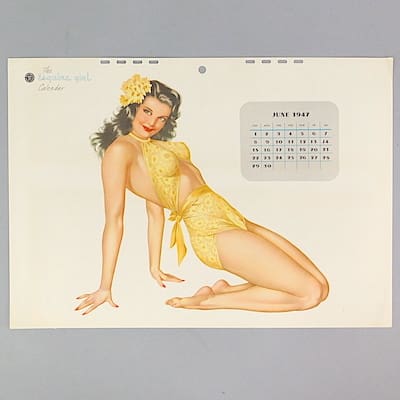
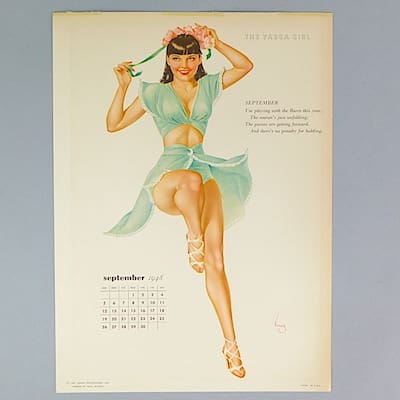
Vargas, Alberto (1896 – 1982)
The most famous and best respected of all the pin-up girl artists. Born Febuary 9th 1896 in Arequipa, Peru, he died in 1982. The word ‘Vargas’ has actually been applied to almost every kind of pin-up subject – a fitting tribute to the most famous and talented glamour artist of all time. He was the son of respected portrait photographer Max Vargas. His father secured an apprenticeship for Vargas at Julien Studios in Switzerland in 1915. He studied in Zurich and Geneva before leaving Europe because of the war and arriving on Ellis Island in October 1916.
Vargas maintained a full schedule throughout the 1920’s, working for a diverse group of clients in addition to the Follies and Paramount. He painted front covers for Tatler and Dance magazines, did hairstyle illustrations for Harper’s Bazaar, and even designed some countertop displays for Old Gold cigarettes. Yet he still found time to paint his favourite Ziegfeld Follies stars for his own pleasure, including the daring Shirley Vernon, whose 1927 portrait was preserved in his private collection.
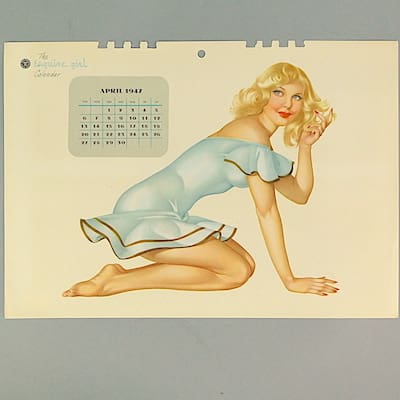
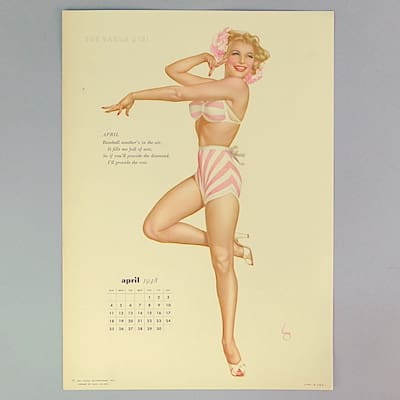
After two lucky breaks, producing lobby paintings for Ziegfield Follies in the 20’s and Hollywood portraits of stars in the 30’s, Vargas was approached to provide artwork for the newly started Esquire Magazine in 1940. When Vargas and Esquire went their separate ways in 1946, the artist immediately embarked upon a project to publish his own yearly calendar. In the meantime, the magazine published an Esquire Calendar for 1947 that consisted completely of unsigned Vargas paintings. By the time Vargas’ 1948 calendar was published, Esquire had a court order barring the artist from selling or distributing any product bearing the name ‘Varga’, which the magazine had copyrighted.
In 1950, a court ruled that Vargas would have to sign all his subsequent paintings with his full name. Although he worked into the 1970s, his best work was produced from 1940 – 1947 which was when he produced the famous Varga girls centre folds, and calendar works for the new Esquire magazine mens magazine.
Varnier, R
Sculptural artist working during the deco years. Made statues and car mascots in shelter, ivory and bronze and ivory.
Villanis, Emmanuel, (1858 – 1914)
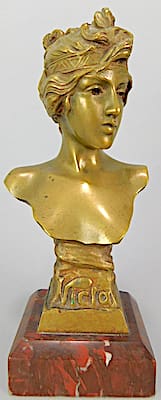
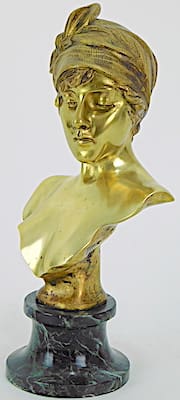
Born in France to Italian parents, he was educated in Italy, but work and exhibited in France in the Salon de Paris and at the Paris Exposition Universelle where in 1889 he received an honourable mention. The realistic expression of the eyes of his subjects is due to his innovative technique of deep cut, he was strongly committed to the Art Nouveau movement, and together with Moreau, Bouval, Luidgi, Picault, Barrias, he produced some of the most remarkable studies of the powerful, sensual and yet subtle female form.
His sculptures where cast by well known foundries such as Vrai Bronze Garanti Paris, fabrication Francais, Societe des Bronzes, Eugene Blot.
Villeneuve – Jacques Louis Robert (1865 – 1933)
Born in Basson, France, January 1865 and died Paris February 1933. Pupil of Injalbert and Thomas. He exhibited at the Salon des Artistes Francais. Won 3rd class medal (1897) / 2nd class medal (1899) / 1st class (1904). Also was awarded Legion d’honneur in 1906. Produced mainly genre groups, and classical, heroic and historical scenes, and busts of his contemporaries.
Villien, Andre
Meal worker producing art nouveau and deco items such as bowls, vases jugs and boxes. He worked in conjunction with a variety of other artists including Schneider & Louis Dage. Dage made the majolica slip wear and then it was clad by Villien in gilt bronze mounts and handles. Schneider made glass vases which were adorned with Villien Metalwork. Stunning quality and highly sought after.
Andre Villien, marked “A.V. Paris, l’etain Francais , Depose a la Marquise de Sevigne”, active 1905-1924, production most likely 1915 to 1920’s.


Voysey, Charles, A (1847 – 1941)
Originally trained as an english architect, designing buildings and whole interiors including wallpapers, textiles and furniture strongly influenced by the English Arts and Crafts movement mostly to commission. His furniture was hand-made in native woods such as oak and beech with his own very distinctive style.