
I am unable to reply to emails seeking information on Art Deco artists so I have put all my knowledge gained over 40+ years into one place. I will be updating these pages from time to time when new information becomes available and if you have information on Art Deco artists that I don’t have, please email it to me at info@sheryls-artdeco.com. Once verified, I will place on these pages.
There are a few publications available with knowledge of founders and sculptors – of which, notable are: Art Deco and other Figures by Bryan Catley, Dictionary of Sculptors in Bronze by James Mackay, Chiparus – Master of Art Deco by Alberto Shayo, Bronzes; Sculptors and Founders by Berman (Schiffer Books), also by Schiffer – Art Deco Sculpture and Metalware by Alfred W. Edward and Art Deco Sculpture by Victor Arwas. Some of these books I have for sale on the website.
A – B – C – D – E – F – G – H – I – J – K – L – M – N – O – P – R – S – T – U – V – W – Z

Ablett, William (1877 – 1937)
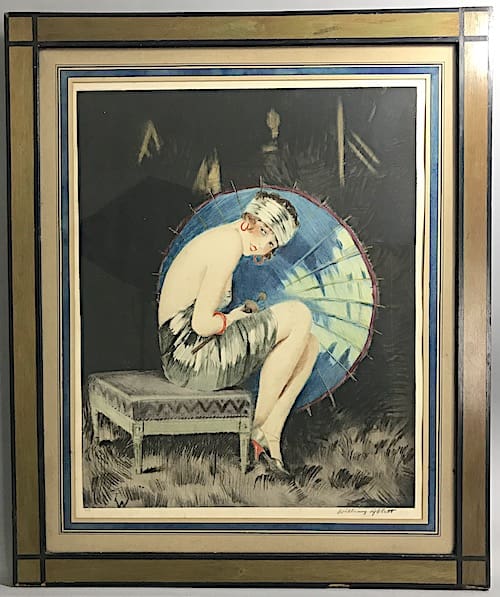
English painter, designer and engraver who lived in Paris most of his life. At the age of 20 he entered the École Nationale Supérieure des Beaux-Arts as a foreign student and was a regular exhibitor at the Société Nationale des Beaux-Arts from 1910 to 1936. He began working with engravings during the early 1920s for magazines and reviews of which generally his works were of female figures related to fashion and the decorative arts.
In 1920 Ablett began working in prints and became one of the finest artists and interpreters of the Boudoir style of art, most famously popularised by his contemporaries Louis Icart, Jean Hardy and Paul Emile Felix.
In 1930, he became a Chevalier de Legion d’Honneur, and was elected to the Royal Academy of Arts. In 1937 he was fatally injured in a car accident near the Bois de Boulogne, and died the following morning at Beaujon Hospital.
Adnet brothers, Jacques (1900 – 1984) & Jean (1900 – 1995)
Jacques was a French interior designer & architect born in Chatillon-Cologny in 1900. Trained at the Ecole des Arts Decoratifs Paris. He worked with Selmersheim and Rapin and Dufrane, selling his items which included modernist furniture and lighting through La Maitrise and Saddler.
He lived and worked with his Twin brother Jean until 1928 when he took over the firm of Sue et Mare. During the 1950’s he created furniture and his works were commissioned for UNESCO and other prestigious buildings, including at the Elysée Palace.
Often working in collaboration with his twin brother Jean who was the display manager for galleries Lafayette and their joint works were marked JJ Adnet. Little information is known on Jean.
Aichele, Paul (1870 – 1940)
Born in Germany he first exhibited at the Berlin Art Exhibition of 1891, showing a statuette of a Bacchante. The following year he became a member of the German Academy of Arts. Subsequently he participated in the Berlin exhibitions, the Crystal Palace Exhibition in Munich and the Dusseldorf Arts Exhibition, mainly genre and allegorical figures.
Aladin
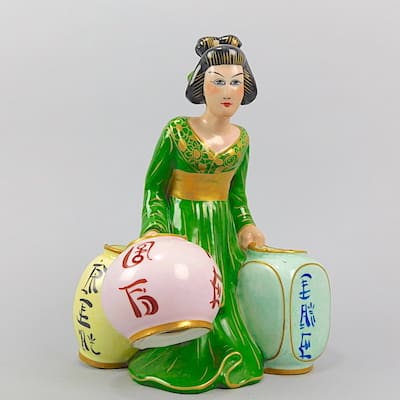
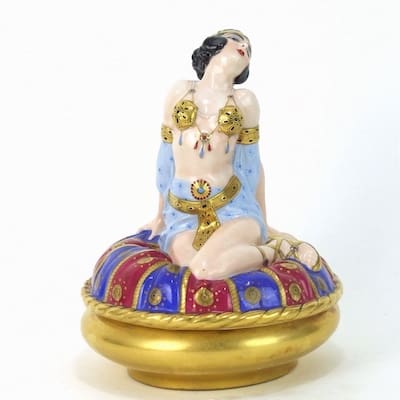
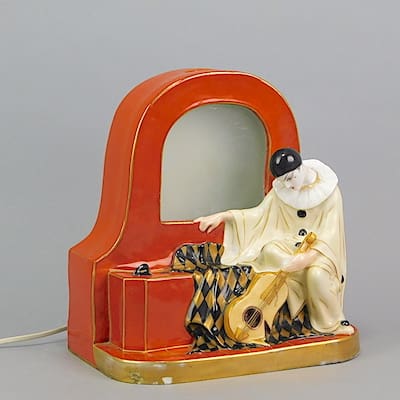
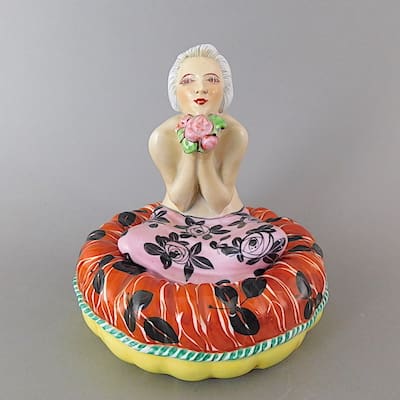
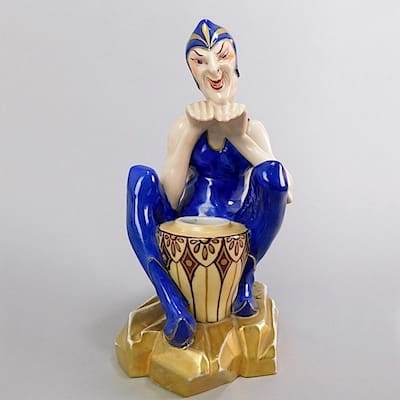
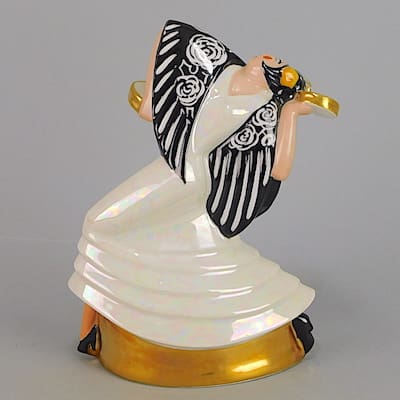
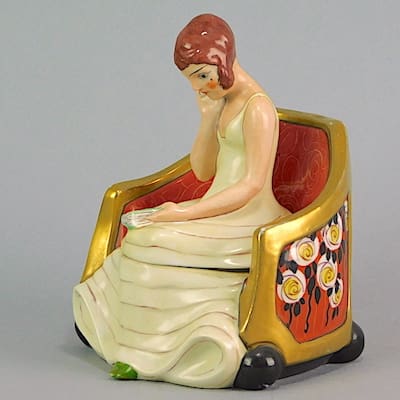
Mr. Clain was the founder of the Aladin brand, which produced a number of ceramic objets d’art in the 1920s-1930s, including subjects created by Pierre Traverse and produced in porcelain. He learned ceramics at the Renoleau factory in Angoulême, where he also worked with sculptors. Finally, in 1944-46, he moved to Le Mans, where he set up the “Sélection” art gallery.
Aladin items are top quality and they produced items such as figural ink pots, ink stands, night lights, statues, flacons, perfume lamps and ashtrays. Aladin also produced pieces designed by various designers and some of the statuary artists – Leyritz, Roser, Godard, Bever and Kelety to name a few.
Many pieces were unmarked, some marked Aladin or Aladin Luxe and also some marked AR. Aladin items are now highly sought after worldwide.

Alliot – Lucien Charles Edouard (1877 – 9 March 1967 in Nanteuil-lès-Meaux, France)
Alliot was born on the 16th on November 1877 in Paris. He was a pupil of Louis Ernest Barrias and Jules Felix Coutan. Alliot was well known for his figurative sculptures which he exhibited from 1905 until 1934 at the Salon de Paris – receiving a third place award in 1907 and first place in 1920. When he finished exhibiting he became a jury member at the Salon evaluating sculptural works from 1934 to 1939.
He produced items made of spelter, terracotta, ceramics, bronze and ivory (chryselephantine) and bronze. Used the pseudonym Luce. He died in 1967.
Alonzo, Dominique
Female artist – born in Paris in the late 19th century. She was a pupil of Falguiere and exhibited her works at the Salon des Artistes Francais from 1912 until 1926. Most of her statues were small and art nouveau but she did produce a few deco pieces.
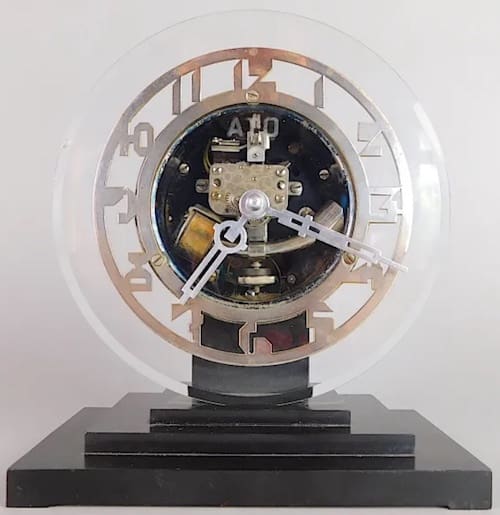
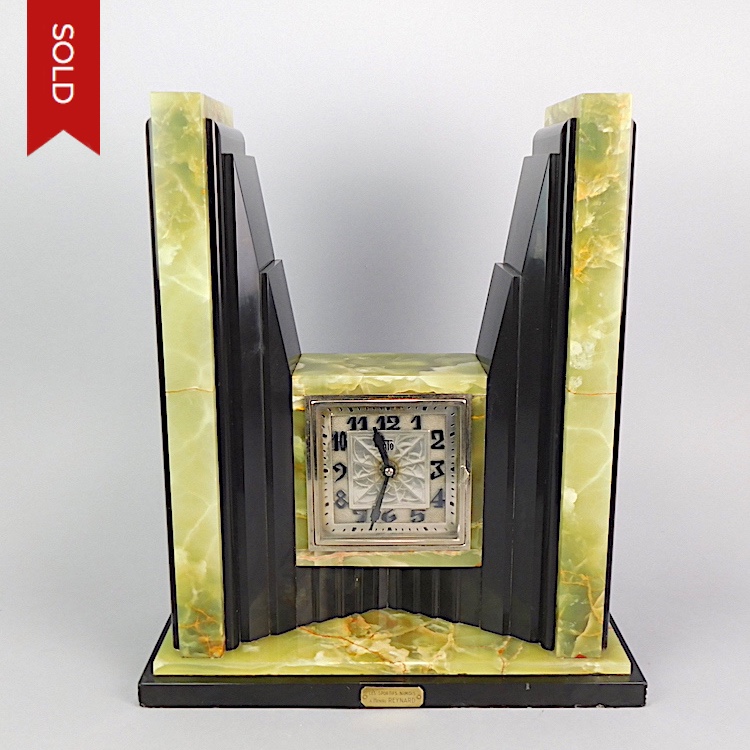
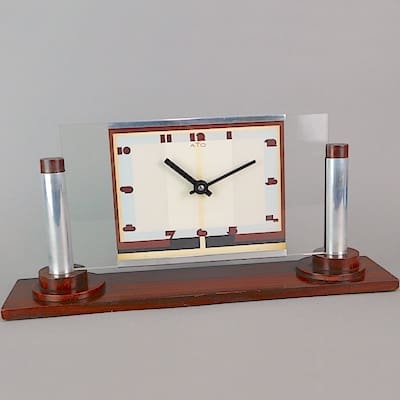
ATO – Leon Hatot (1883 – 1953)
Hatot was a French clock maker and is famous for producing one of the first battery operated clocks in the 1920’s. He patented the classic form of pendulum which used a magnet and coils to impulse the pendulum. This is achieved by the current from the first coil switching a transistor which supplies a larger current to the second coil at the right moment.
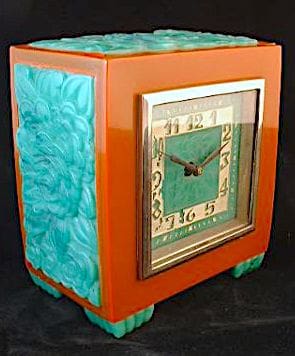
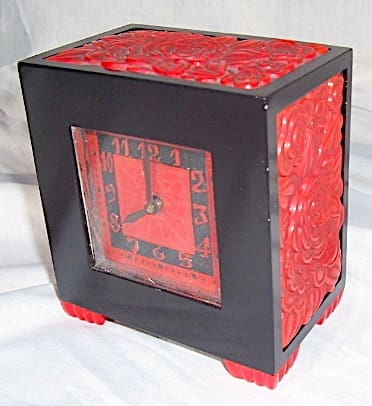
Lalique supplied some of the glass panels for some of his clocks. He used various materials to produce his clocks, marble, onyx, bakelite, wood and glass. Most of his clocks are very stylish and deco and although the batteries are no longer available to power them – a good clock man can usually do a conversion to a modern battery.
ATO clocks are now highly sought after world wide.
Argentor Werke
The firm Argentor Werke was located in Wimbergerstraße, in one of the inner districts of Vienna, a site where different metal-ware companies gathered together. It was the custom at the time for companies with reputation to invite artists to create designs which then were to be cast.
Argy-Rousseau, Gabriel (1885 – 1953)
Master craftsman and famous for his handcrafted pate de verre techniques – unlike many other glass decorators he never mass produced. Studied at the National High School for Ceramics in Sevres in 1902, completed a degree and first exhibited his work in Pate de Verre in 1914 at the Salon des Artistes.
Pate de verre consists of powdered glass moulded and then fused by heat. Changed his name to his wife’s maiden name in 1913. Displayed at most of the Paris Salons in the 1920’s. His work is highly sought after today and fetches a high premium.
Artus, Charles
It was originally believed that Artus was an early pseudonym of Max Le Verrier. We now know this was not the case. In fact Charles Artus was an artist who created stylised bird items working in conjunction with Max Le Verrier in the early years producing such statues as the pelican and the marabout in max’s first workshop which was founded in 1919 at 100 Rue du Thetre, Paris.
He produced items of stylised bird subjects from bookends and ashtrays to ceiling lights.


Original Artus inverted negatives from the Le Verrier foundry.